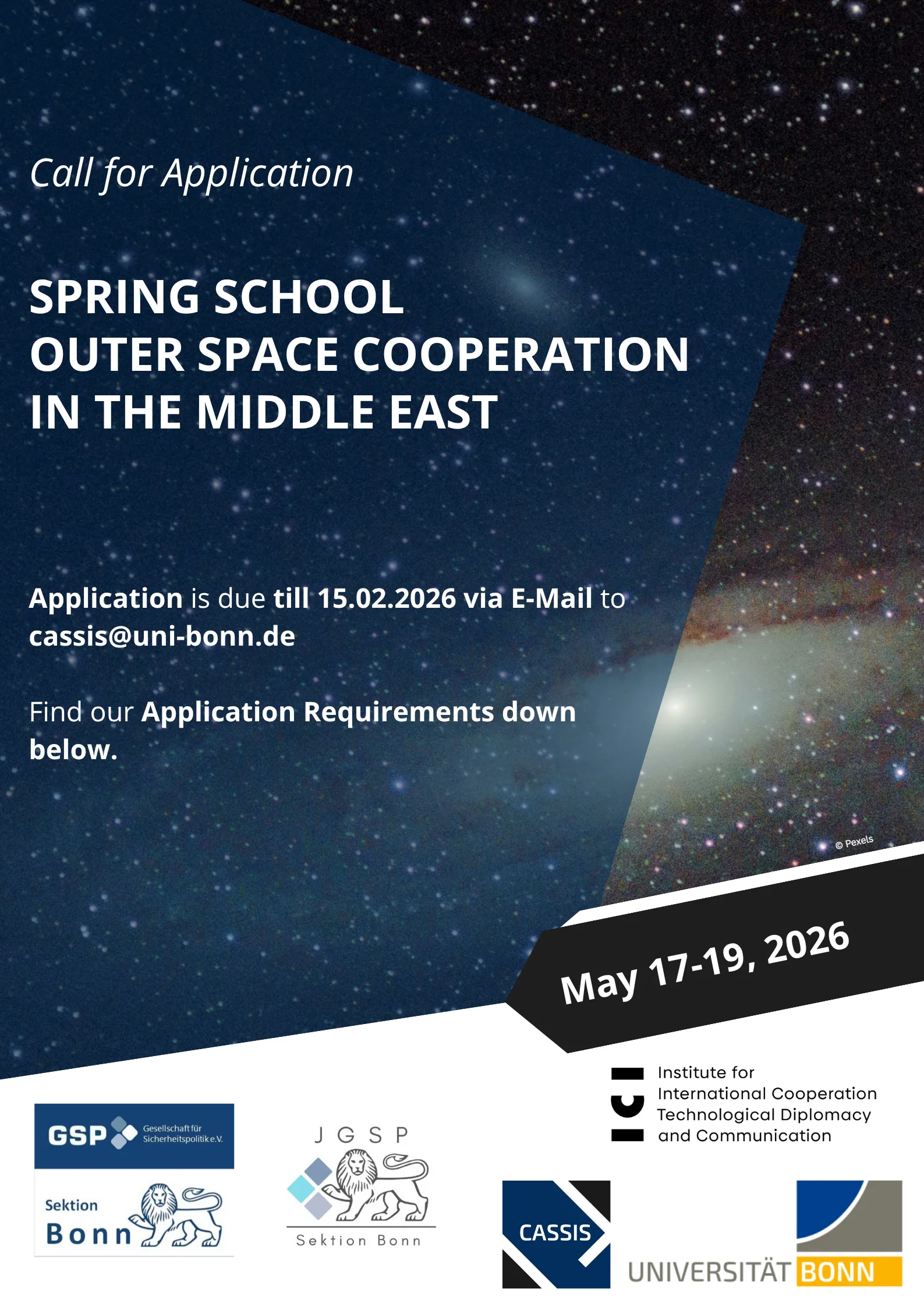
Spring School: Outer Space Cooperation in the Middle East 2026
May 17-19, 2026 | University of Bonn, Festsaal
The space-based infrastructure has performed various vital tasks for our planet, which have become indispensable for the functioning of all ultra-modern industrialized societies. This includes error-free navigation via global satellite-based navigation systems such as Galileo, Glonass, or GPS (Global Positioning System), but also the functioning of energy supply, stock exchange trading, ATMs, weather forecasting, the recording of data and trends on climate change and the transmission of critical data and information to the military. The dependence on satellites for communication, data collection, and crisis response will continue to increase. As dependence on space resources grows, so does the potential to influence the people, institutions, systems, and states that depend on them through strategic technological control.
Extraterrestrial space, the fifth domain of human civilization — after land, sea, air, and cyberspace — is a place for the projection of power and power politics of and between states with enormous economic, military, and strategic consequences for the entire international community. As a new arena of competition, space is exposed to tensions between major powers, while middle and regional powers are also interested in space due to its promising strategic advantages.
The space sector is also gaining strategic importance in the Middle East region. Investments in space technologies promote economic progress and create new industries and jobs. Countries such as the United Arab Emirates and Saudi Arabia are investing heavily in their space programs as part of their national visions, which are driving technological progress and regional development. Other actors, such as Egypt and Oman, are also increasingly interested in the sector. Developing comprehensive space infrastructures requires considerable investment, increasing competition for limited resources. Military applications in space intensify the security dilemma, while geopolitical alliances further influence competition.
At the same time, space also offers opportunities for cooperation among countries in the region, particularly between states that pursue ambitious space programs. This harbors enormous potential for economic progress, security and regional stability, technological innovation, and international cooperation.
The spring school is organized by the Center for Advanced Security, Strategic and Integration Studies (CASSIS), the Institute for International Cooperation, Technological Diplomacy and Communication (ICI), the Young Society for Security Policy (JGSP), and the Society for Security Policy (GSP), bringing together expertise from various institutions to explore the strategic, technological, and cooperative dimensions of space.
Participation by invitation only.
Application is due until 15th of Febuary via E-Mail: cassis@uni-bonn.de
For further information see the PDF below.
© CASSIS
Application Requirements
Programm
To Be Announced