24. September 2025

Prof. Dr. Andreas Heinemann-Grüder on ARD's Tagesgespräch program analyzing Russia's military provocations Prof. Dr. Andreas Heinemann-Grüder on ARD's Tagesgespräch program analyzing Russia's military provocations

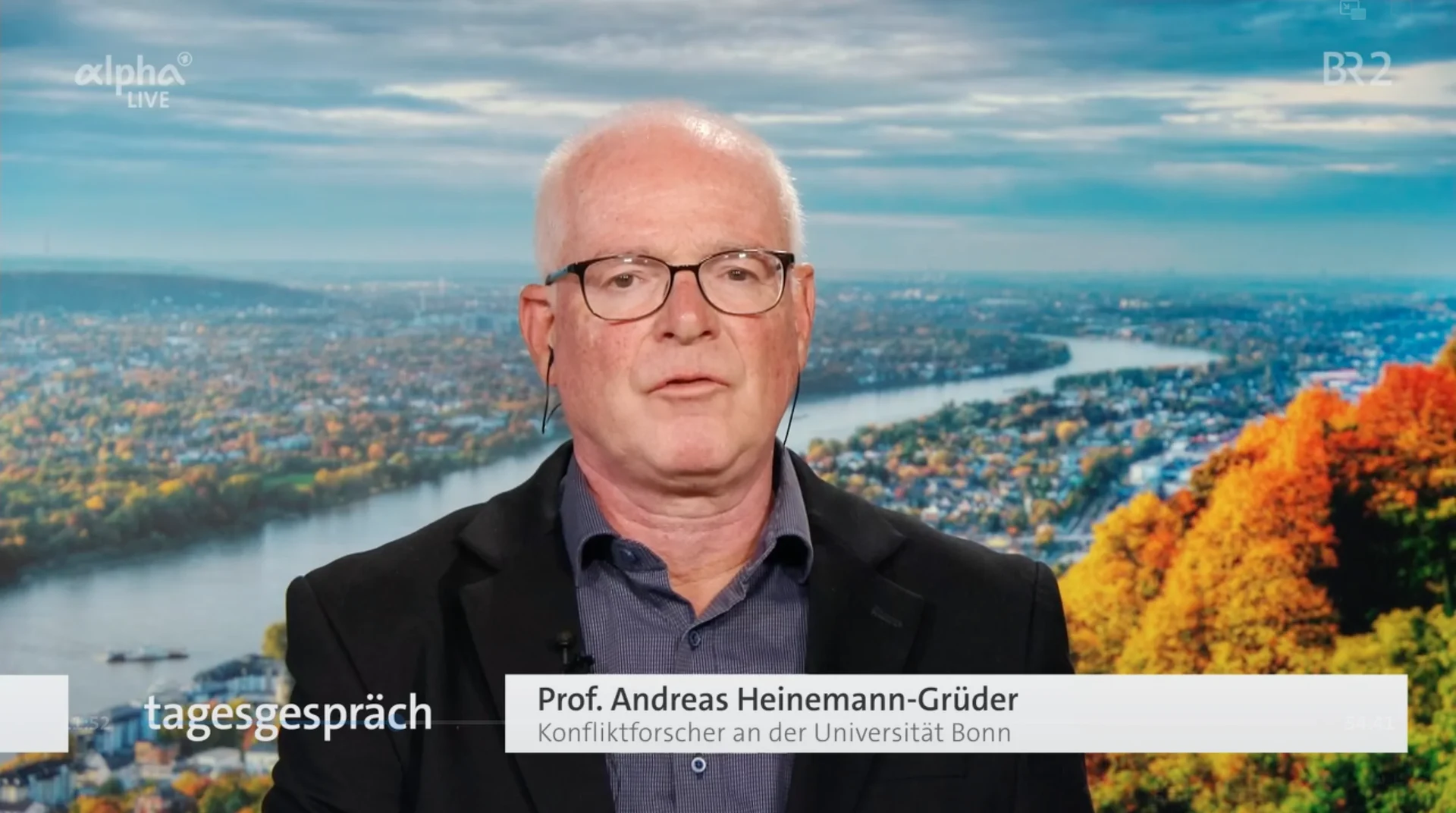
On September 24th, Prof. Dr. Andreas Heinemann-Grüder appeared on ARD alpha's Tagesgespräch program to explain Russia's violations of NATO airspace from a security policy perspective and to classify them in relation to previous examples of Russian military provocations.

Security expert Prof. Dr. Andreas Heinemann-Grüder appeared on ARD alpha's Tagesgespräch program on September 24th.
Security expert Prof. Dr. Andreas Heinemann-Grüder appeared on ARD alpha's Tagesgespräch program on September 24th. © ARD alpha
Download all images in original size The impression in connection with the service is free, while the image specified author is mentioned.
Please fill out this field using the example format provided in the placeholder.
The phone number will be handled in accordance with GDPR.

Prof. Dr. Andreas Heinemann-Grüder first addressed a military incident from 2015, when the Turkish Air Force shot down a Russian Sukhoi Su-24 fighter jet that had entered Turkish airspace. The shooting down of the fighter jet, which had flown in from Syria and continued to violate Turkish airspace despite repeated warnings from the Turkish military, had been effective in the security expert's view, as Russia's air force had not violated Turkish airspace since then. 

In the course of the discussion, Prof. Dr. Heinemann-Grüder expressed the view that Germany could learn a lot from Ukraine in terms of air defense. Efficient early warning systems, such as those used in Ukraine—for example, warning messages sent to citizens' smartphones—could contribute significantly to national and NATO alliance defense, according to Prof. Dr. Heinemann-Grüder.

Prof. Dr. Andreas Heinemann-Grüder is a Senior Fellow at CASSIS, an Extraordinary Professor of Political Science at the University of Bonn and a Senior Researcher at the Bonn International Centre for Conflict Studies (BICC)

Wird geladen