Measurement of Digital Dependence
Technological dependence became a major concern of the German and European discussions on digitalization. European innovation policies aim at reducing Europe’s “digital dependence” by investing in artificial intelligence, semiconductors, and other digital technologies. However, the aspiration to realize digital self-determination requires accurate measurements to assess and compare European vulnerabilities in the technological sector.
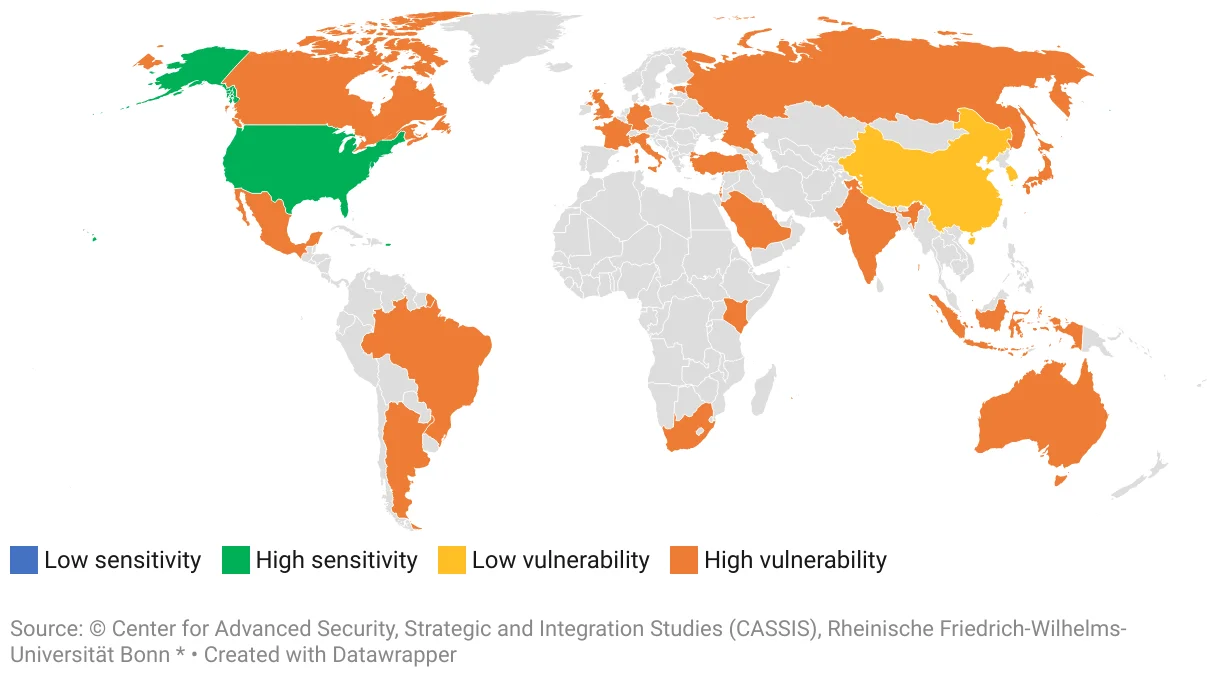

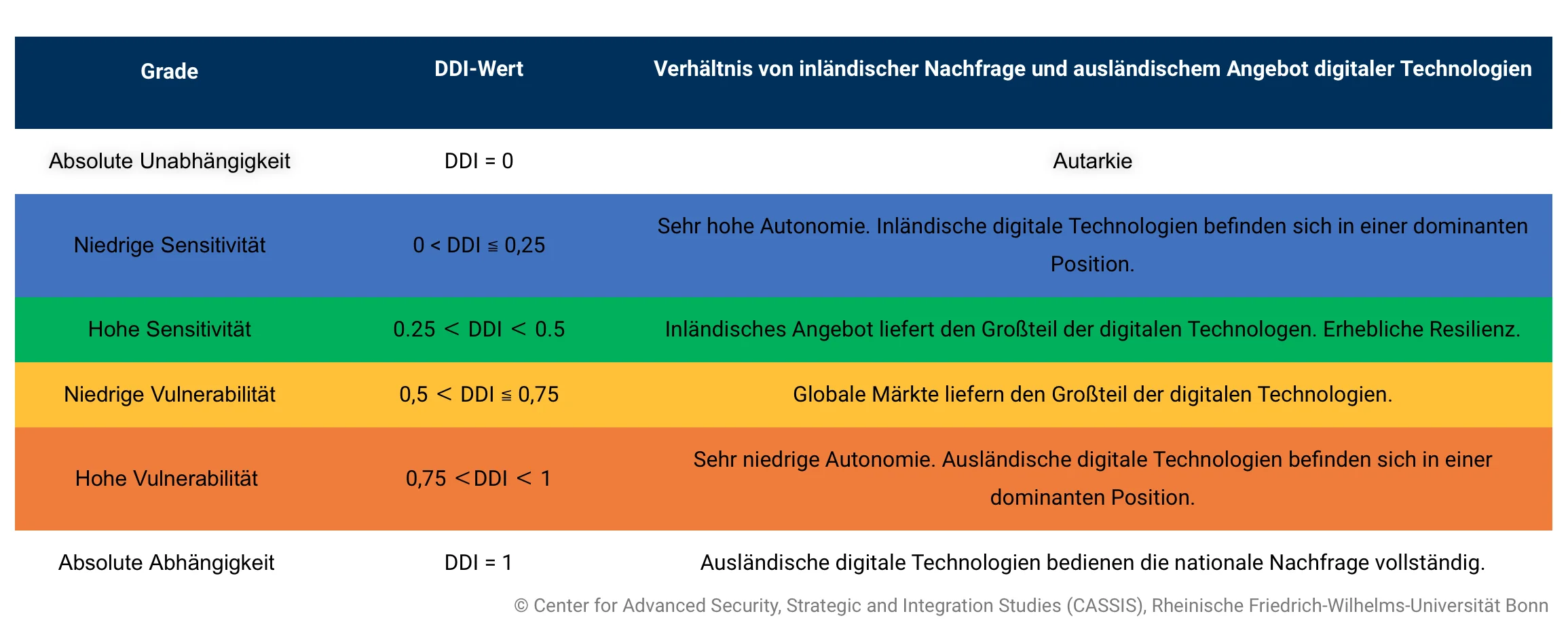
The Digital Dependence Index (DDI) measures the dependence level on different technology sectors (e.g., hardware and software) of 23 countries. The primary indicators focus on ICT trade, communication infrastructures, and intellectual property, i.e., patents (see methodology). The level of dependence is scaled from low sensitivity to high vulnerability. This helps to understand the complexity of digital sovereignty and to explore the prospects of reducing digital dependence on foreign countries. This index aims to provide an empirical foundation to develop new strategic digital policies (see working paper). The DDI compares 23 dependence indicators based on three different data sets (see Data sources). The DDI Maps, country profiles, and long-term trends demonstrate important aspects and dimensions of digital dependence. The digital dependence status of countries can be distinguished as follows: DDI scores between 0.5 and 1 indicate being more digital dependent; DDI scores between 0 and 0.5 indicate being less digital dependent, in other words, more autonomous.
Degrees of Dependence
Publications
- Mayer, M., & Lu, Y.-C. (2025). Global structures of digital dependence and the rise of technopoles. New Political Economy, 1–20. Link
- Nock, P. (2023). European technological autonomy: Realities, aspirations, and illusions. Bonn Vision Lab – Envisioning Zeitenwende, Beyond Berlin Regiogruppe Rheinland Polis, 180, 26–28. Link
- Mayer, M., & Lu, Y.-C. (2023). Illusionen der Autonomie? Europas Position in den globalen digitalen Abhängigkeitsstrukturen. SIRIUS – Zeitschrift für Strategische Analysen, 7(4). Link
- Gassner, M., & Schallhart, B. (2023). Saudi-Arabiens digitale Abhängigkeit: Balanceakt zwischen Modernisierung und „Daten-Nationalismus“. Digital Dependence Index Country Studies, (3). Link
- Prinsen, J. (2023). Südkoreas digitale Abhängigkeit: Staatliche Steuerung als Erfolgsrezept. Digital Dependence Index Country Studies, (2). Link
- Almasi, N., & van Helden, P. (2023). Deutschlands digitale Abhängigkeit: Von Souveränität kann keine Rede sein. Digital Dependence Index Country Studies, (1). Link
- Mayer, M., & Lu, Y.-C. (2022). Europa hat die Konsequenzen seiner digitalen Abhängigkeit noch kaum erkannt. Konrad-Adenauer-Stiftung. Link
- Mayer, M., & Lu, Y.-C. (2022). Digital Dependence Index: Methodology. Link
- Mayer, M., & Lu, Y.-C. (2022). Digital autonomy? Measuring the global digital dependence structure. Link
Media Coverage
- Buchholz, L. & Schelling, A. (2025, March 26). Europa muss digitale Souveränität erlangen: Zeit für eigene Cloud-Infrastruktur. Frankfurter Allgemeine. Link
- The Economist (2024, October 8). America v China: who controls Asia’s internet? Link
- Schulmann, H. & Waidner, M. (2024, June 27). Wieso Deutschland in digitaler Abhängigkeit verharrt. Frankfurter Allgemeine. Link
- Steiner, F. (2024, January 17). Deutschlands Unternehmen unzufrieden mit eigener Digital-Abhängigkeit. heise online. Link
- Institut économique Molinari (2023, May 24). Il manque en Europe 10 400 milliards d’euros de capitalisation boursière. Link
- Bayer, M. (2022, December 5). Offener Brief an die Bundesregierung: Digitale Souveränität Deutschlands ist in Gefahr. Computerwoche. Link
- Grün, O. & Mayer, M. (2022, December 1). Digitalisierung: Erst abgehängt, dann abhängig. Tagesspiegel. Link
- Krempl, S. (2022, December 1). IT-Mittelstand warnt vor digitaler Abhängigkeit von China und USA. heise online. Link
- Mayer, M. (2022, October 11). In der digitalen Abhängigkeit. Golem. Link
- Jekel, A.-K. (2022, September 21). Blogreihe Digitale Souveränität. Univention. Link
- Hardthöhenkurier (2022, May 11). Partnerschaftliche Lösungen aus Deutschland für Deutschland. Link
- Deutschlandfunk Nova (2022, May 4). Digitale Autonomie in der EU "kaum mehr als eine Illusion". Link
- Die Welt (2022, May 3). Europäische Digitalwirtschaft fällt weiter zurück. Link
- Deutsche Welle (2022, May 3). 调研:实现“数码自主“ 德国任重道远. Link